
Intent
Concentrate expensive intelligence generation on the weeks most likely to matter in the UI while preserving readable historical output.
Context
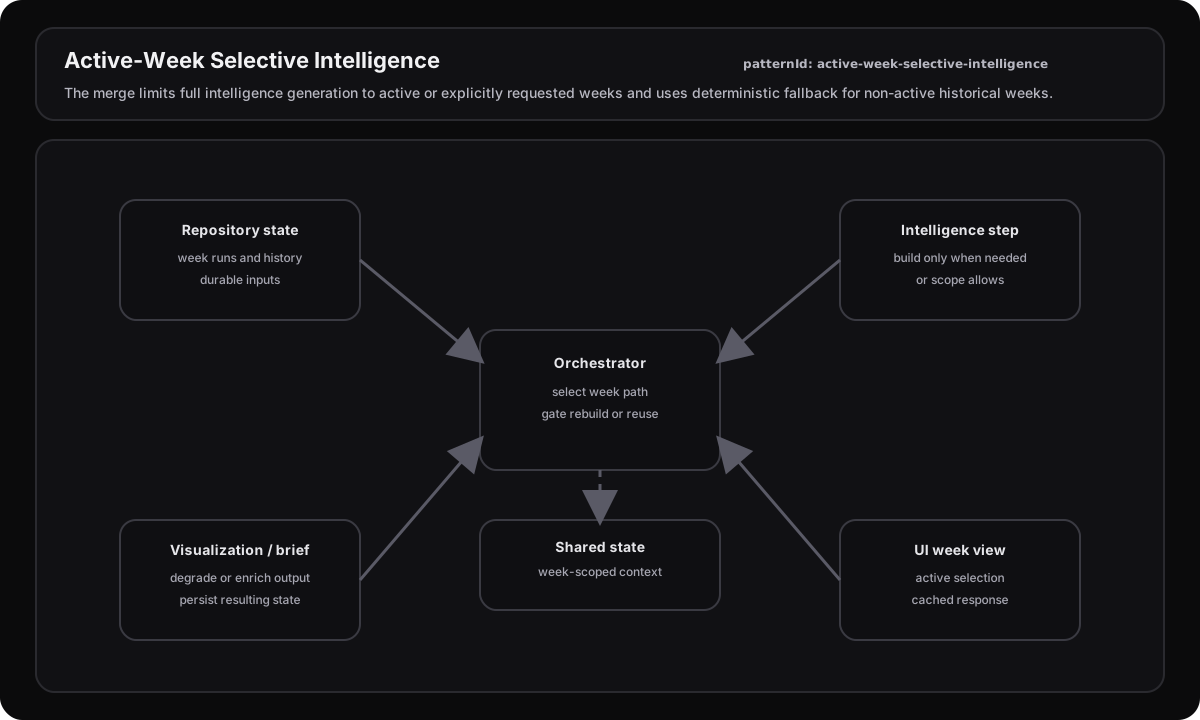
During multi-week orchestration, only active or on-demand weeks run full intelligence, while non-active historical weeks can receive deterministic brief generation. The merge limits full intelligence generation to active or explicitly requested weeks and uses deterministic fallback for non-active historical weeks.
Agentic profile
- System shape: hybrid
- Orchestration mode: hybrid
Agent-to-agent interaction
- Present: true
- Mechanism: shared-state
- Evidence: The orchestrator marks active weeks and the snapshot service adjusts generation behavior for those shared week contexts.
Tool protocols
- MCP: absent
- Tool calling: present
- Evidence: Full intelligence is limited to active or explicitly requested weeks, while historical weeks degrade gracefully.
Optimisation target
- Primary: cost
- Secondary: latency, reliability
- Notes: Historical weeks are degraded to deterministic behavior unless explicitly requested.
Simplicity vs autonomy
- Position: simplicity
- Rationale: The system constrains autonomous generation to active or on-demand weeks.
Forces
- Historical weeks still need a usable view.
- Running full LLM-backed intelligence for all weeks is costly and slow.
Solution
Select active weeks, set enable_intelligence accordingly for each week context, and in snapshot recompute choose between LLM brief generation and deterministic brief fallback based on enable_intelligence and comparison availability.
Implementation signals
- Orchestrator computes
active_weeksbefore the per-week loop. - SnapshotService chooses deterministic brief generation when intelligence is disabled for a week.
Evidence
- The orchestrator selects active weeks and toggles intelligence generation for each one.
- The snapshot service falls back to deterministic brief generation when a historical week is not active.
Consequences
Benefits
- Keeps current-week experience richer than bulk historical processing.
- Reduces cost and response time for multi-week orchestration.
Costs
- Historical weeks may present less rich intelligence unless explicitly requested.
- Active-week selection becomes a critical product heuristic.
Failure modes
- Wrong active-week selection can hide intelligence where users expect it.
- Fallback briefs may feel inconsistent relative to LLM-generated weeks.
Reuse notes
- Useful when only a subset of periods needs full generative analysis and the remainder can degrade gracefully.
- Use it when cost matters more than maximizing autonomous generation everywhere.
Confidence
Medium. Confidence is medium because the pattern is evidenced directly in the PR132 code paths and tests, with breadth consistent with a stable pattern rather than speculation.