
Intent
Reduce unnecessary LLM work while keeping week views correct when data actually changes.
Context
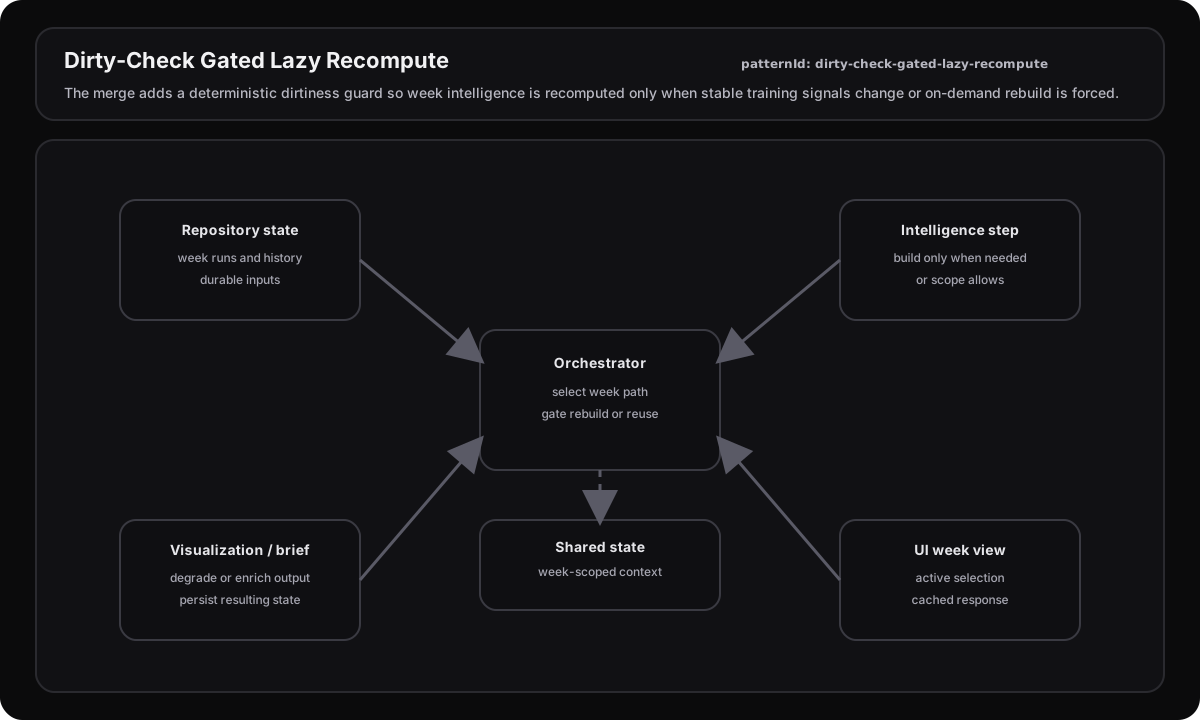
The orchestrator tests dirtiness before reusing or rebuilding cached week snapshots and before skipping historical intelligence. The merge adds a deterministic dirtiness guard so week intelligence is recomputed only when stable training signals change or on-demand rebuild is forced.
Agentic profile
- System shape: hybrid
- Orchestration mode: event-driven
Agent-to-agent interaction
- Present: true
- Mechanism: shared-state
- Evidence: A deterministic dirty check decides whether the shared week state should trigger another intelligence run.
Tool protocols
- MCP: absent
- Tool calling: present
- Evidence: Expensive intelligence steps run only after a deterministic comparison says the week changed.
Optimisation target
- Primary: latency
- Secondary: cost, reliability
- Notes: Avoids rerunning LLM-backed intelligence when stable training metrics have not changed.
Simplicity vs autonomy
- Position: balanced
- Rationale: A deterministic gate reduces unnecessary autonomy without removing lazy rebuild behavior.
Forces
- Weekly navigation can trigger repeated requests for the same data.
- LLM-based recomputation is more expensive than deterministic cache checks.
Solution
Compare only stable summary fields such as weekly distance, run count, pace, and consistency against the cached intelligence snapshot; rebuild only when they differ beyond tolerance or when mode is on-demand.
Implementation signals
SnapshotService.is_week_dirty(...)compares projected snapshot fields against WeeklySummary.- Orchestrator branches into reuse or recompute based on
is_dirtyandmode.
Evidence
- The snapshot service compares stable summary fields before deciding whether reuse is safe.
- The orchestrator branches into reuse, skip, or recompute based on the dirty-check result.
- Tests confirm that historical weeks are skipped initially and rebuilt only when requested.
Consequences
Benefits
- Reduces repeated agent invocations.
- Makes lazy week navigation faster and cheaper.
Costs
- Requires maintenance of the stable-field comparison set.
- Can miss semantic changes not captured by the dirty metrics.
Failure modes
- False negatives can preserve stale intelligence.
- False positives can cause unnecessary recomputation.
Reuse notes
- Use when expensive agent outputs are downstream of a smaller stable metric set that can be compared deterministically.
- Use it when latency matters more than maximizing autonomous generation everywhere.
Confidence
High. Confidence is high because the pattern is evidenced directly in the PR132 code paths and tests, with breadth consistent with a stable pattern rather than speculation.