
Intent
Reduce implicit coupling between orchestration internals and UI rendering logic.
Context
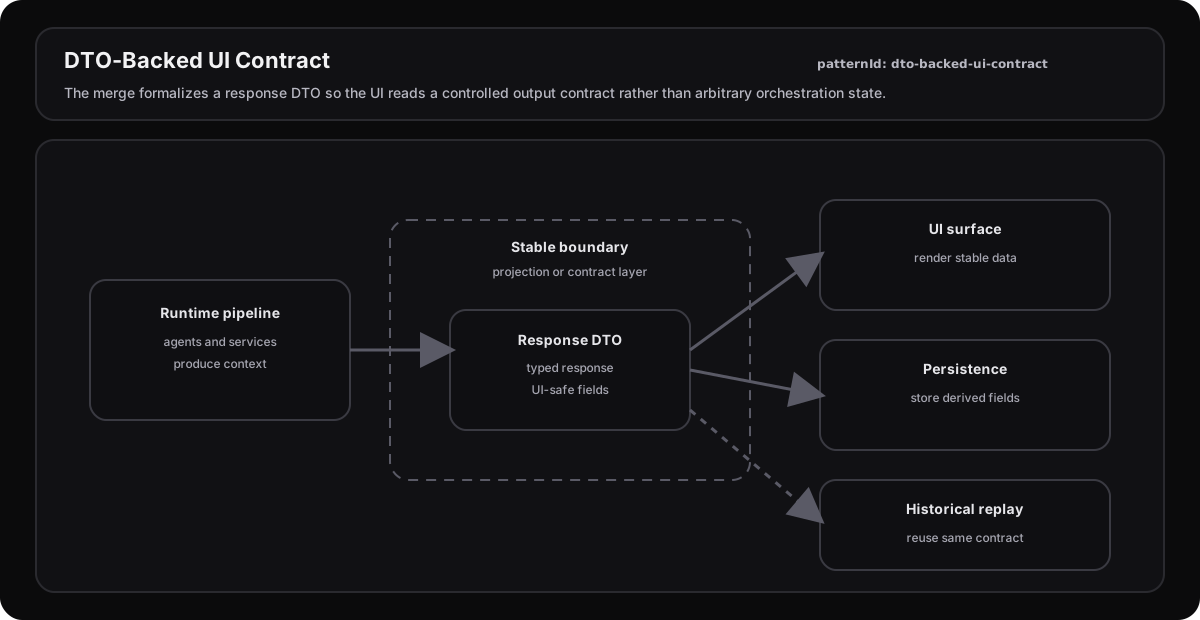
The orchestrator now returns a structured RunnerAPIResponse with intelligence_snapshot included as a first-class field. The merge formalizes a response DTO so the UI reads a controlled output contract rather than arbitrary orchestration state.
Agentic profile
- System shape: hybrid
- Orchestration mode: sequential
Agent-to-agent interaction
- Present: false
- Mechanism: unknown
Tool protocols
- MCP: absent
- Tool calling: present
- Evidence: The orchestrator returns one structured response object that the UI reads directly.
Optimisation target
- Primary: developer-velocity
- Secondary: reliability
- Notes: DTOs reduce UI dependence on internal orchestrator structure.
Simplicity vs autonomy
- Position: simplicity
- Rationale: The UI reads a constrained response object instead of deep orchestration state.
Forces
- UI code previously depended on loosely shaped dictionaries and internal state.
- Multiple execution paths need a common, serializable response surface.
Solution
Define a dataclass DTO, populate it centrally in the orchestrator, and update the UI helpers to use attribute access instead of reconstructing response shape locally.
Implementation signals
- New
RunnerAPIResponsedataclass in application/dto. - UI code shifts from dict-style
.get(...)assumptions to orchestrator-returned response attributes.
Evidence
- A dedicated response DTO defines the backend contract returned to the UI.
- The orchestrator constructs that DTO centrally at the end of execution.
- The UI reads the response object directly instead of rebuilding a free-form dict shape.
Consequences
Benefits
- Creates one explicit backend-to-UI contract.
- Makes serialization failures easier to isolate.
Costs
- Adds an extra mapping layer in the orchestrator.
- Requires DTO updates whenever product surface changes.
Failure modes
- DTO fields can become a grab bag if not curated.
- Fallback DTO generation may mask root-cause serialization issues.
Reuse notes
- Useful when a single orchestrator serves a UI that is evolving faster than the internal pipeline structure.
- Use it when developer-velocity matters more than maximizing autonomous generation everywhere.
Confidence
High. Confidence is high because the pattern is evidenced directly in the PR132 code paths and tests, with breadth consistent with a stable pattern rather than speculation.