
Intent
Separate persisted training truth from the richer state needed to drive UI and coaching interactions.
Context
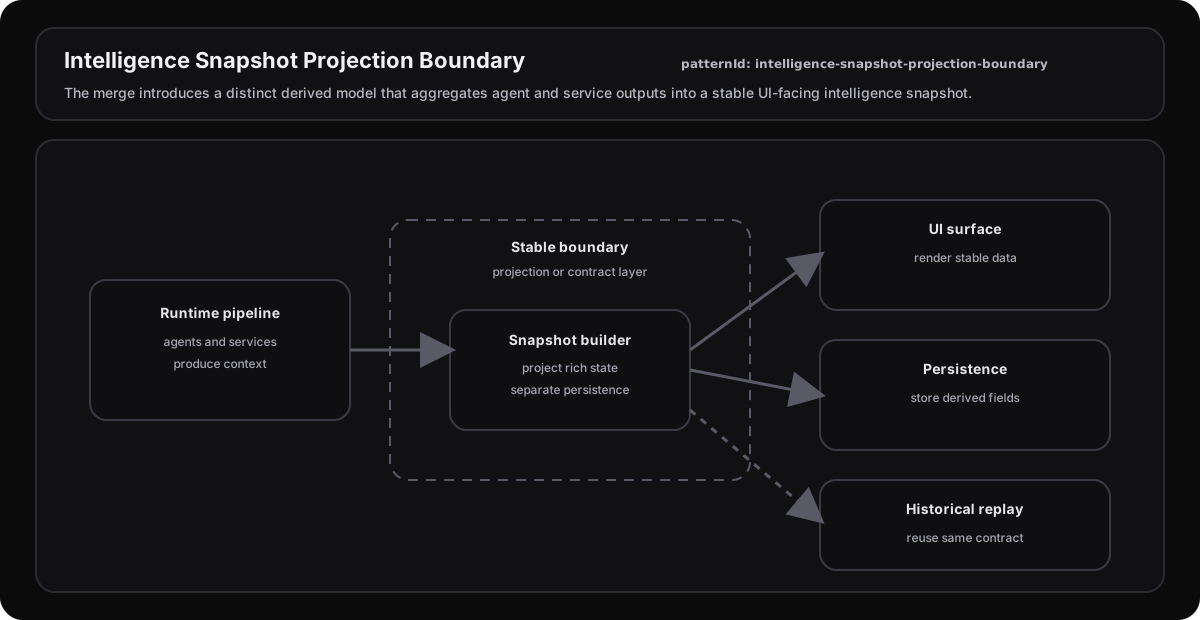
This appears in the refactor that positions WeeklySnapshot as persisted truth and RunnerIntelligenceSnapshot as the UI-facing derivative. The merge introduces a distinct derived model that aggregates agent and service outputs into a stable UI-facing intelligence snapshot.
Agentic profile
- System shape: hybrid
- Orchestration mode: hybrid
Agent-to-agent interaction
- Present: true
- Mechanism: shared-state
- Evidence: The orchestrator and snapshot builder coordinate through one shared runtime context.
Tool protocols
- MCP: absent
- Tool calling: present
- Evidence: Agent outputs are gathered first and then projected into one UI-facing snapshot.
Optimisation target
- Primary: reliability
- Secondary: quality, developer-velocity
- Notes: The projection boundary reduces direct UI dependence on orchestration internals.
Simplicity vs autonomy
- Position: balanced
- Rationale: Agent outputs remain autonomous, but the final UI contract is system-shaped through a deterministic projection layer.
Forces
- UI needs richer state than persisted weekly aggregates alone provide.
- Persisted storage should remain simpler than the full runtime intelligence model.
- Orchestrator internals were previously leaking into UI rendering.
Solution
A dedicated builder projects PipelineContext into RunnerIntelligenceSnapshot using safe extraction from summary, positioning, recommendation, trend, goal, and chart state, then the snapshot is serialized separately for DTO delivery.
Implementation signals
- New
build_intelligence_snapshot(...)function replaces direct UI dependence on raw orchestrator state. - New
RunnerAPIResponse.intelligence_snapshotfield carries the serialized projection.
Evidence
- A dedicated builder creates a UI-facing snapshot from already-computed context instead of recomputing business logic.
- The response DTO exposes
intelligence_snapshotas an explicit product surface. - The orchestrator attaches the intelligence snapshot before returning the response contract.
Consequences
Benefits
- Makes the UI consume a stable boundary object instead of ad hoc orchestrator fields.
- Allows week-scoped intelligence to be rebuilt or cached without changing the UI contract.
Costs
- Adds another representation layer to maintain.
- Requires careful synchronization between projected fields and underlying context changes.
Failure modes
- Projected fields can drift from source context if builder logic is incomplete.
- If the serializer omits fields, the UI may still need direct fallbacks.
Reuse notes
- Use this when agent/service pipelines produce many intermediate fields but the consumer should depend on one stable aggregate view.
- Use it when reliability matters more than maximizing autonomous generation everywhere.
Confidence
High. Confidence is high because the pattern is evidenced directly in the PR132 code paths and tests, with breadth consistent with a stable pattern rather than speculation.