
Intent
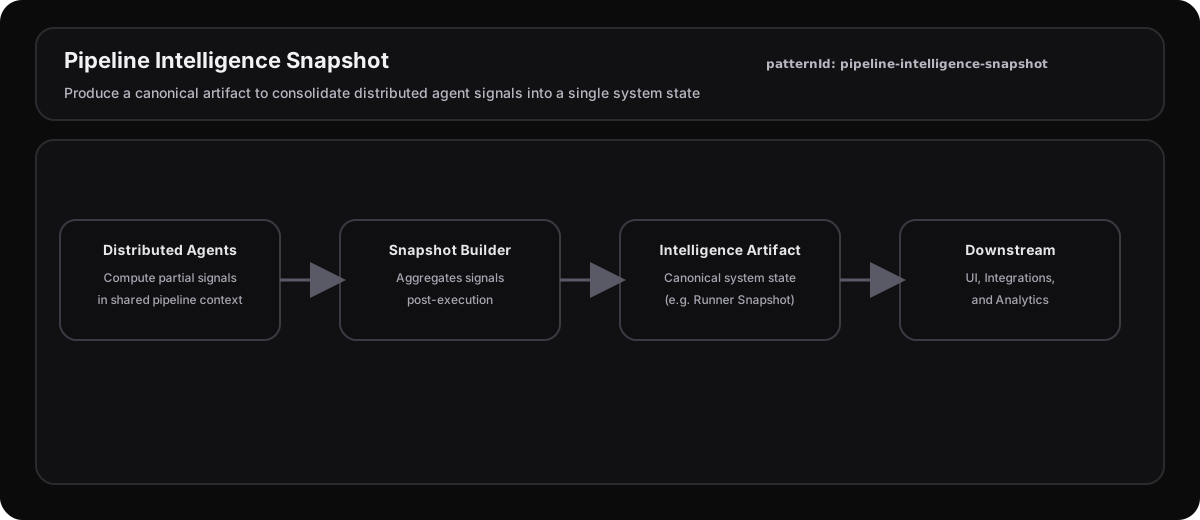
Provide a single canonical artifact representing the system’s computed intelligence state after a multi-step agentic pipeline executes.
The pattern consolidates distributed signals produced by agents and services into one object that downstream surfaces (UI, integrations, analytics) can consume consistently.
Context
This pattern appears in agentic pipelines where multiple agents compute different aspects of a system state.
Typical architecture pressures include: • multiple agents generating partial outputs • UI or integrations consuming many independent signals • need for a coherent “system intelligence state”
In the runner intelligence system, signals such as: • weekly training snapshot • trend analysis • runner positioning • goal trajectory • next run recommendation • coaching insight
are computed across different pipeline steps and agents.
Without consolidation, the final system state remains distributed across multiple context fields.
The pattern emerges to produce a canonical intelligence artifact.
Agentic profile
•	System shape: hybrid
•	Orchestration mode: hybrid
Agent-to-agent interaction
•	Present: false
•	Mechanism: shared-state
•	Evidence: src/core/pipeline/context.py
Agents operate sequentially and in parallel via a shared PipelineContext.
Tool protocols
•	MCP: absent
•	Tool calling: present
•	Evidence: src/agents/insights/agent.py
Agents invoke LLM tools but do not communicate directly with each other.
Optimisation target
•	Primary: reliability
•	Secondary: developer-velocity, integration-readiness
•	Notes: The snapshot stabilizes the system state and simplifies downstream consumption.
Simplicity vs autonomy
•	Position: balanced
•	Rationale:
Agents retain autonomy in producing signals, but the system introduces a simple aggregation artifact to maintain coherence.
Forces
•	Multiple agents produce partial intelligence outputs.
•	UI and integrations require a coherent system state.
•	Context objects accumulate loosely structured fields.
•	Observability needs a stable representation of runner state.
•	Future integrations (Strava, WhatsApp) need a stable interface.
These pressures push toward introducing a canonical artifact layer.
Solution
Introduce a post-pipeline intelligence artifact that aggregates signals produced by agents and services.
Key characteristics: 1. The artifact is generated after pipeline execution. 2. It aggregates already-computed values, introducing no new logic. 3. It becomes the canonical representation of system intelligence.
Example structure:
RunnerIntelligenceSnapshot
Containing signals such as: • training state • health signal • runner positioning • goal trajectory • coaching insight • next run recommendation • weekly metrics
The artifact is stored in:
context.intelligence_snapshot
and can be consumed by:
UI external integrations analytics systems notifications
Implementation signals
Observable signals of this pattern include: • A dedicated snapshot model representing aggregated intelligence. • Snapshot creation after pipeline execution. • Pipeline context exposing a canonical intelligence object. • Observability events emitted when the snapshot is produced. • UI or integrations referencing the snapshot instead of individual signals.
Evidence
Examples from the runner intelligence system: • src/core/intelligence/runner_intelligence_snapshot.py — canonical intelligence model • src/core/intelligence/snapshot_builder.py — aggregation logic • src/core/pipeline/context.py — snapshot stored in pipeline context • src/agents/orchestrator.py — snapshot generated after pipeline execution
Observability: • event runner_intelligence_snapshot_generated
Consequences
Benefits • Establishes a single system intelligence artifact. • Simplifies UI and integration consumption. • Improves observability of system state. • Reduces signal drift across agents.
Costs
•	Introduces an additional aggregation layer.
•	Requires discipline to prevent business logic creeping into the snapshot builder.
Failure modes • Snapshot becomes a second source of truth if logic is duplicated. • Agents begin depending on the snapshot instead of context inputs. • Aggregation layer grows into a business logic layer.
Reuse notes
Where it fits • Agentic pipelines with multiple intelligence-producing agents. • Systems producing a coherent user-facing state from many signals. • Architectures needing stable integration interfaces.
Where it does NOT fit
•	Simple single-agent systems.
•	Systems where state is already produced by a single service.
Minimal version
A minimal implementation can be:
context.system_snapshot = Snapshot(…)
produced once at the end of orchestration.
Preconditions
•	Pipeline context already contains structured outputs.
•	Signals are computed before aggregation.
•	Snapshot introduces no new business logic.
Confidence
Medium
The pattern is clearly evidenced in the runner intelligence architecture but has not yet been validated across multiple independent systems.