
Intent
Ensure rapid experimentation does not create architectural debt by embedding an explicit architecture audit and refactor step directly inside the development workflow.
Context
This pattern appears in experimentation-heavy systems where features evolve quickly and architectural drift becomes likely.
Observed in:
- Iterative AI system development
- Agent-based architectures
- Continuous refactoring environments
The pressure emerges from a tension between fast feature iteration and long-term architectural stability.
Without an explicit governance mechanism, the system accumulates structural debt.
Agentic profile
- System shape: multi-agent
- Orchestration mode: hybrid
Agent-to-agent interaction
- Present: true
- Mechanism: shared-state
- Evidence:
src/core/pipeline/context.py#PipelineContext
Tool protocols
- MCP: absent
- Tool calling: present
- Evidence:
src/agents/insights/agent.py#generate_insights
Optimisation target
- Primary: reliability
- Secondary: developer-velocity
- Notes: The pattern trades small development friction for long-term system stability.
Simplicity vs autonomy
- Position: balanced
- Rationale: The workflow preserves architectural discipline while still allowing rapid experimentation.
Forces
- Rapid iteration introduces structural drift.
- Refactors are often postponed when delivery pressure is high.
- Agent-based architectures amplify coupling risks.
- Architecture reviews are traditionally periodic rather than continuous.
- Structural problems compound quickly if not addressed immediately.
Solution
Introduce an architecture governance loop inside the delivery workflow.
Instead of merging changes directly after validation:
- Implement the change
- Validate behavior
- Run an architecture audit
- Refactor structural issues
- Stabilize and merge
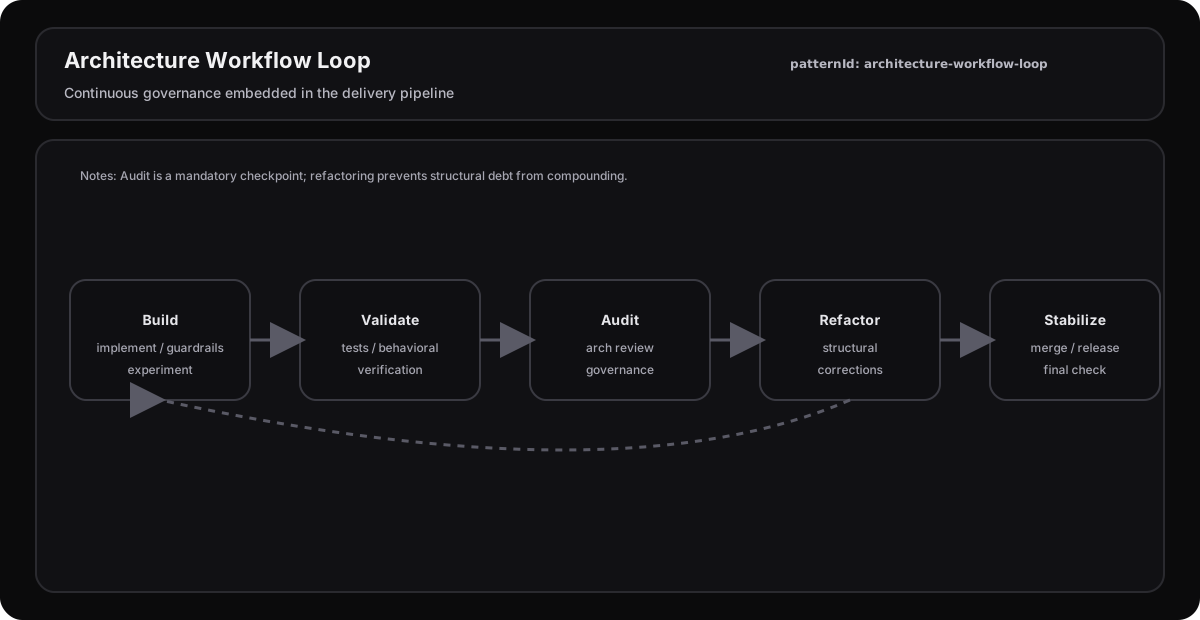
This creates a continuous cycle:
Build → Validate → Audit → Refactor → Stabilize
The architecture audit becomes a mandatory checkpoint before merge, ensuring structural corrections happen immediately.
Implementation signals
Observable signals this pattern exists:
- Explicit architecture audit step before merge
- Refactor commits triggered by architectural violations
- Workflow documentation referencing architecture checks
- Audit-driven refactor phases during feature development
- Architecture-focused test suites validating system structure
Evidence
runner-agentic-intelligence/src/agents/orchestrator.py— orchestration refactoring during pipeline migrationrunner-agentic-intelligence/src/core/pipeline/context.py— typed PipelineContext introduced after architecture audit- Weekly learning artefacts documenting audit → refactor cycles
- Architecture audit reports highlighting violations and structural corrections
Consequences
Benefits
- Prevents architecture drift during rapid experimentation
- Surfaces structural problems early
- Encourages disciplined refactoring
- Improves long-term system maintainability
Costs
- Slower merge cycle for individual changes
- Additional cognitive overhead during development
Failure modes
- Audits become superficial checklists instead of structural analysis
- Teams bypass the audit step under delivery pressure
- Refactor step becomes optional instead of mandatory
Reuse notes
This pattern fits:
- Systems evolving through continuous experimentation
- AI and agent-based architectures
- Small teams maintaining architecture discipline without formal review boards
This pattern does not fit well in:
- Static systems with infrequent changes
- Projects with heavy centralized architecture governance
Minimal version:
Build → Validate → Architecture Audit → Merge
Preconditions:
- Team understands architectural boundaries
- Audit criteria are clearly defined
- Refactors are accepted as part of normal delivery
Confidence
Medium
Observed clearly during multiple refactor cycles in the runner intelligence system, but limited validation across additional projects or teams.
⸻