
Intent
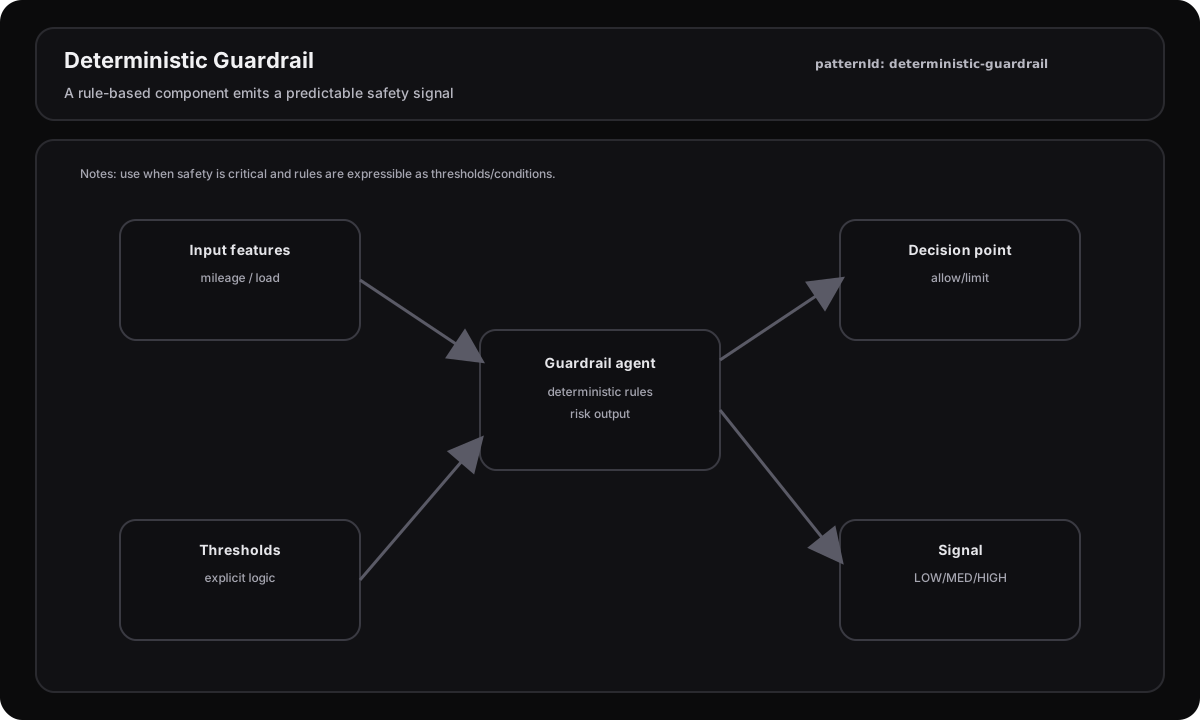
Enforce safety constraints without relying on probabilistic LLM outputs.
Context
Applied to injury-prevention risk assessment where rules are well-defined (for example, mileage spikes). This pattern fits scenarios where safety is critical and the decision logic is better expressed as explicit thresholds and conditions.
Agentic profile • System shape: unknown • Orchestration mode: unknown
Agent-to-agent interaction • Present: unknown • Mechanism: unknown • Evidence: unknown
Tool protocols • MCP: unknown • Tool calling: unknown • Evidence: unknown
Optimisation target • Primary: unknown • Secondary: unknown • Notes: unknown
Simplicity vs autonomy • Position: unknown • Rationale: unknown
Forces • Safety criticality • Rule clarity • LLM unreliability
Solution • Implement a dedicated agent class that encodes safety heuristics as hard-coded logic. • Produce a risk assessment signal deterministically from input features and reports.
Implementation signals • No LLM client in agent • Rule-based logic (if/else)
Evidence • src/agents/guardrail_agent.py#InjuryFatigueGuardrailAgent — Uses explicit thresholds for mileage increase
Consequences
Benefits • Guaranteed safety check • Explainable logic • Fast execution
Costs • Limited by defined rules • Requires manual rule maintenance
Failure modes • False positives/negatives if heuristics are flawed
Reuse notes • Wrap critical safety checks in non-LLM agents. • Prefer when constraints can be expressed as clear rules and must be predictable.
Confidence
High — the guardrail agent is evidenced as an explicit, heuristic-based component with threshold logic.